April 2026 — JEPX manual trading screens eliminated

Probability-Calibrated
Bid Intelligence
for JEPX

A working system that replaces single-price forecasts with complete probability distributions — calibrated on 2022–2024 JEPX data and validated on a full unseen year of 2025 real JEPX observations across nine independent out-of-sample windows.

84–91%
Directional Hit Rate
2025 out-of-sample
4 yrs
Real JEPX Data
2022 spike → 2025 solar era
9
Independent OOS Windows
2022 → full-year 2025
100%
Data Sovereignty
Your infrastructure only
Scroll
The Problem

Point forecasts lag behind in blind auctions

JEPX operates a blind single-price auction. You must commit quantities before the market clears, without seeing competitors' bids. A single predicted price tells you nothing about how much capital to risk or how to spread exposure.

The correct response to an uncertainty range of ¥11,000 ± ¥200 is fundamentally different from ¥11,000 ± ¥3,000. A point forecast cannot express this distinction — and with solar penetration creating bimodal intraday regimes, it never will.

This system maintains a full probability distribution over all possible clearing prices for each delivery period — updated continuously as market data arrives.

Conventional Approach
This System
"Tomorrow's price will be ¥12,000"
70% probability of ¥10,500–¥14,000, with upside tail risk to ¥18,000
Fixed bids based on point estimates
Dynamic bid curves that adapt to uncertainty
Opaque, black-box recommendations
Every bid traceable from raw data to final quantity
Lags behind during bimodal intraday regimes
Multimodal distributions captured naturally
Empirical Validation

Tested across every regime Japan's power market has seen — including a full unseen year of 2025 data

2022 — Ukraine Spike
74.3%
¥100,000/MWh peaks
Sharpe0.318
Max DD−7.9%
Trades/day3.4
2023 — Normalising
66.0%
Post-crisis stabilisation
Sharpe0.413
Max DD−41.0%
Trades/day12.9
Q4 2024 — Winter Transition
66.5%
Morning ramp + afternoon shoulder
Sharpe0.427
Max DD−9.7%
Fire rate19%
Q1 2024 — Winter Peak
72.9%
~1,143 executed trades
Sharpe0.224
Max DD−3.6%
Trades/day12.7
Q2 2024 — High Solar
88.1%
~999 trades — solar arc fix
Sharpe0.420
Max DD−0.4%
Trades/day11.1
2025 Out-of-Sample Validation — Full Unseen Year Tested with real 2025 JEPX data
Q1 — Winter Peak
84.4%
Sharpe 0.949 DD −3.9% T/d 4.3
Q2 — High Solar
86.0%
Sharpe 1.056 DD −2.8% T/d 5.1
Q3 — Summer Shoulder
87.2%
Sharpe 1.636 DD −0.6% T/d 0.9
Q4 — Winter Transition
90.8%
Sharpe 1.824 DD −0.9% T/d 1.7
Full-Year 2025
84–91%
Hit Rate — all quarters
Best Sharpe1.824
Worst drawdown−3.9%
Calibration data2022–2024
2025 data in trainingNone
All results are from strict out-of-sample evaluation — the model was calibrated on data preceding each test window and never shown test data during training.
As at 31 March 2026, the system incorporates full-year 2025 seasonal coverage, calibrated seasonal suppression guards, and a concentration risk cap derived from 2025 trade journal analysis. 2025 figures use zero 2025 training data — complete holdout. Simulated PnL is pre-cost and directional only. Real-world net results will reflect your organisation's transaction costs, execution infrastructure, and market impact.
Commercial Value

Even a modest 5% edge has compounding value

Even a modest 5% directional edge above random — moving from 50% to 55% — adds 5 extra wins and removes 5 losses per 100 trades. At institutional position sizes, this compounds materially over a trading year. The illustration below uses this conservative floor.

Illustration: Conservative Floor (5% edge above random)

Price captured per trade ¥500/MWh (conservative)
Net swing per 100 trades 10 outcomes (5% edge × 2)
Active trading days per year ~250 days
Incremental edge outcomes/year 200 additional wins
This system has demonstrated 34–41 percentage points above random across a full unseen year of 2025 data — meaning the 5% floor above is highly conservative. Figures remain pre-cost; net results will reflect your organisation's execution costs and market impact.
Participant Profile Typical Daily Volume Illustrative Annual Impact (¥) Approx. USD Equivalent
Independent power producer ~20 MWh ¥1M range ~$7K
Regional trading desk ~100 MWh ¥5M range ~$35K
Utility portfolio ~500 MWh ¥25M range ~$170K
Institutional trader ~2,000 MWh ¥100M range ~$670K
Your Organisation Let's explore what this could mean for your operations

Figures are illustrative only, based on a conservative ¥500/MWh capture assumption. Actual outcomes depend on position sizing, execution costs, market conditions, and organisational constraints.

System Design

Built for institutional governance

Five specialised components in strict unidirectional flow. No component can override another's decisions. Every recommendation is traceable from raw data to final output with no black-box steps.

1
Market Data Ingestion
Schema validation · Event streaming · Column integrity checks
2
Trading Orchestration
Pipeline lifecycle · Seasonal guard logic · Portfolio-level MW cap · Output persistence
3
Probability Inference Engine
Real-time distribution engine with proprietary market memory
4
Validation Engine
Multi-layer risk filter · Dynamic position scaling
5
Execution Engine
Position sizing · Adaptive stop-loss · Append-only journal
Human Approval Gate
Named trader reviews and confirms every bid before submission

Flow
Unidirectional Flow
Data moves in one direction only. No component overrides another's decisions — eliminates cascading failures at the architectural level.

Audit
Full Audit Trail
Every bid is reconstructable from raw input to final quantity. Append-only trade journal — records are never modified, every run is uniquely identified.

Human
Human in the Loop
The system cannot submit bids without explicit human confirmation. No autonomous execution pathway. A named trader approves every schedule.

Local
Zero External Calls
Runs entirely on your infrastructure. No cloud dependencies, no third-party feeds, no data leaves your environment at any point.
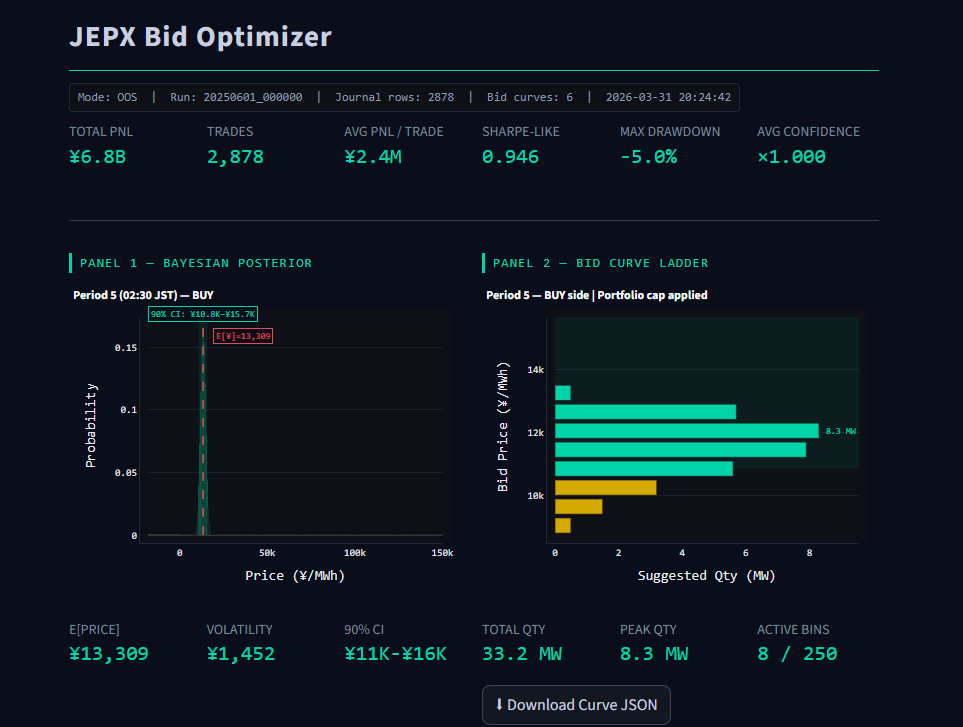
Interface Preview

A walkthrough of the bid optimisation dashboard — from inference to execution

Risk Management

Multiple layers between a signal and your capital

Every proposed trade passes multiple independent checks before reaching your approval queue.
A failing check scales back the position — the system never executes blindly.

01
Edge Detection
Is the expected profit sufficient for the risk taken?
Only genuine, statistically meaningful signals pass. Noise trades are suppressed before they reach sizing.
02
Volatility Alignment
Does position size match current market uncertainty?
Exposure scales automatically with signal quality. Higher uncertainty means a smaller position — not the same position.
03
Temporal Consistency
Does this bid fit historical patterns for this hour?
Guards against recommendations that are correct on average but wrong for a specific time-of-day regime.
04
Capital Exposure Limit
Will this trade breach predefined risk thresholds?
Configurable ceiling on single-period concentration. No position can exceed the agreed capital fraction.
05
Market Regime Filter
Is this the right trade type for this trading session?
Systematic suppression of position types with historically poor performance in specific market windows.
06
Confidence Calibration Guard
Is the system's certainty appropriately calibrated?
Detects and scales back trades when the probability engine is near-uniform — when it genuinely does not know. Overconfidence is treated as a risk factor.
Data Control

This is not SaaS. Your data never leaves.

A complete system design that deploys and operates entirely within your own secure environment. No subscription, no vendor lock-in, no shared infrastructure.

✓ What stays with you
Your price history and trading positions
Your calibration parameters and model state
Your complete audit logs and trade journal
Your competitive strategy and signal intelligence
✗ What you won't need
Cloud hosting for this model if it's not intended for external network
Third-party model parameters or shared model weights
SaaS subscription or per-trade licensing fees
Vendor lock-in or unexplained proprietary formats
Start the Conversation

The April 2026 deadline is fixed.

The question is whether your organisation arrives at it with a validated, proprietary system on your own infrastructure — or with a dependency on external platforms whose incentives may not align with yours.

Available for Collaborative Development

Technical architecture documentation and system design guide
Annotated source code with implementation notes
2025 out-of-sample validation results and trade journal analysis
Validation methodology and backtesting results package
Integration roadmap for your existing trading infrastructure
On-site or remote technical walk-through for your teams
All results are from simulation on real JEPX historical data, including a full holdout year of 2025 data. Live trading requires JEPX and OCCTO API connectivity and your organisation's own execution infrastructure. No SaaS subscription or neural network software required.
Reference

Glossary of Terms

JEPX
Japan Electric Power Exchange — Japan's only wholesale electricity marketplace, where power is bought and sold across 48 half-hourly delivery slots each day.
AR(1) — AutoRegressive Order 1
A time series technique where today's value is informed by yesterday's equivalent value. The 10:00 price distribution is anchored to the previous day's 10:00 distribution — midday prices correlate with previous midday prices, not with today's 09:30 prices.
Bid Curve
A structured schedule of price-quantity pairs submitted to JEPX before the auction closes — specifying how much electricity your organisation will buy or sell at each possible clearing price.
Hit Rate
The percentage of executed trades where the system correctly predicted the direction of price movement. A coin flip produces 50%; 84–91% represents a commercially meaningful and exploitable edge.
Out-of-Sample (OOS) Testing
The system was trained on historical data from one period and tested on a later period it had never seen. This is the standard test for whether a model captures real market structure or merely memorises history.
Probability Distribution
Instead of a single price prediction, the system maintains a complete probability curve over all possible prices for each delivery period — updated in real time as each new market observation arrives. Bid quantities are sized proportionally to this curve, concentrating exposure where confidence is highest.
Sharpe Ratio
Return per unit of risk. Higher is better. Above 0.2 is considered acceptable for a real-market trading system; above 0.4 is strong. Positive throughout all tested windows.
Human-in-the-Loop
The requirement that a named human reviews and approves every bid recommendation before it is submitted to the exchange. The system is architecturally incapable of executing without this confirmation.